Sabbath
The Captain and Ann BarbaraThe Sabbath is the beating heart of Jewish life in Polotzk as Mary Antin remembers it, the one day of the week when the relentless pressures of the Pale of Settlement fall away and the community renews its ancient covenant with God. In a world where the Czar's taxes, police raids, and the constant threat of conscription hemmed Jews in on every side, the Sabbath was a fortress of the spirit, a wall within the wall that the authorities could not breach. It was the day when the clatter of business ceased, the dust of worry was laid, and the peace of God seemed to flood the quiet streets, so that even the meanest hovel sent out its consecrated ray of light through the twilight. For the Jews of Polotzk, the Sabbath was not merely a day of rest but the very expression of their spiritual cravings, the minute observance of traditional rites that gave meaning and structure to lives otherwise pent up within narrow limits and all but dehumanized by the vigilance of the police.
The Weekly Rhythm of Preparation and Observance
The Sabbath began long before sundown on Friday, with a ritual of cleansing and transformation that Antin describes in loving detail. On Friday afternoons, her parents came home early from the store to wash and dress, removing from their persons every sign of labor. The great keys of the store were put away out of sight, and the money bag was hidden in the featherbeds, as if to banish the very thought of commerce from the household. Her father put on his best coat and silk skull-cap, while her mother replaced her cotton kerchief with a well-brushed wig. The children bustled around their parents, asking favors in the name of the Sabbath—begging to wear their new shoes or to be taken across the bridge the next day. While the family adorned themselves in their best, the grandmother superintended the sealing of the oven, the maids washed the sweat from their faces, and the dvornik scraped his feet at the door, each gesture marking the transition from the profane world of work to the sacred time of rest.
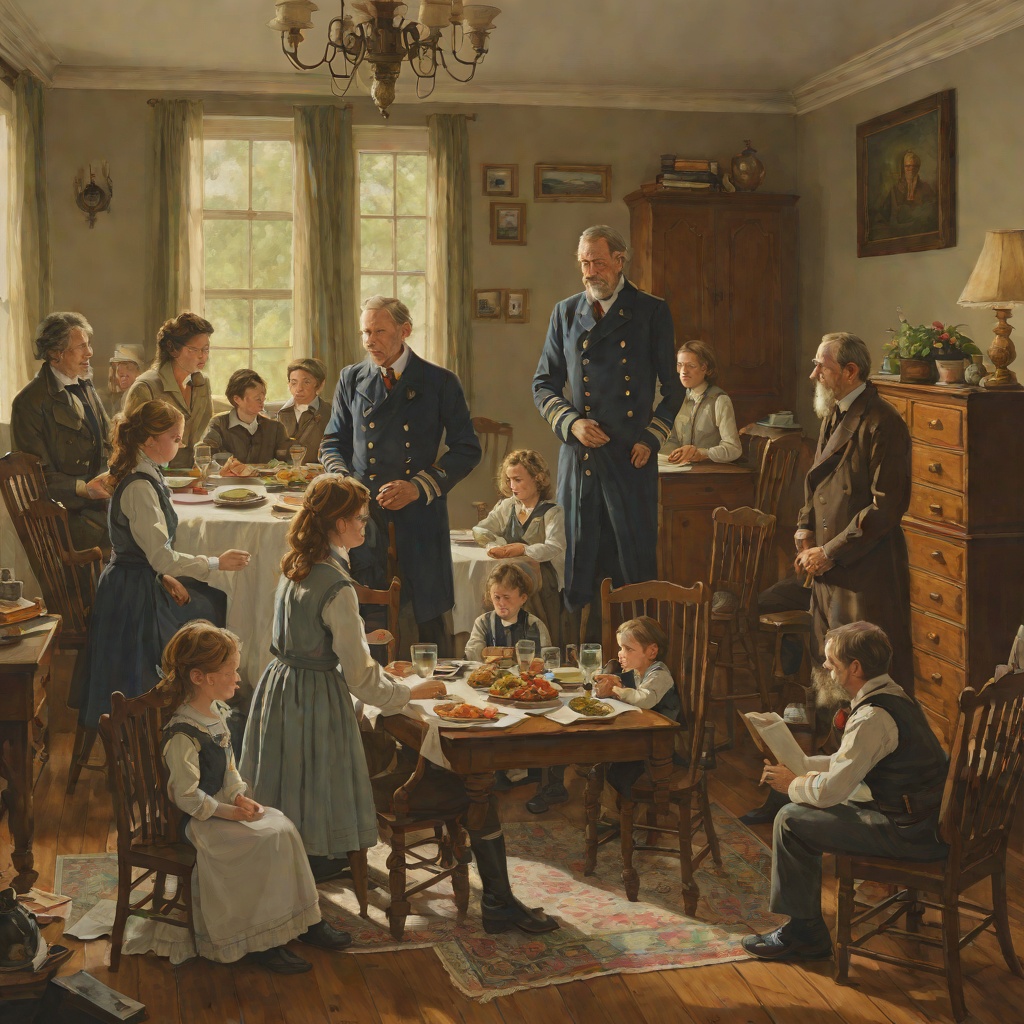
The observance continued with the men and boys going to the synagogue, while the women and girls assembled in the living-room for the candle prayer. The table gleamed with spotless linen and china, with the Sabbath loaf covered by a crocheted doily at the father's place, and beside it the wine flask and kiddush cup of gold or silver. At the opposite end stood a long row of brass candlesticks polished to perfection, with heavier silver candlesticks in a shorter row in front, for the mother and grandmother were very pious and each used a number of candles, while the children and the maids had one apiece. When the men returned from the synagogue, the father called out "Good Sabbath!" and the family answered in kind, and if he brought with him a Sabbath guest—some poor man without a home—the stranger was welcomed and placed in the seat of honor next to the father. The family stood around the table while the kiddush, the blessing over the wine, was said, and if a child whispered or nudged another, the father reproved him with a stern look and began again from the beginning. Only after he had cut the consecrated loaf and distributed the slices were the children at liberty to talk and ask questions, unless a guest was present, when they maintained a polite silence.
The Sabbath as Spiritual Fortress in the Pale
The Sabbath was more than a family ritual; it was the collective spiritual bulwark of a persecuted people. Antin reflects that on a Sabbath or festival, when life was centred in the synagogue, it mattered little what czar sat on the throne or what evil counsellors whispered in his ear. The authorities were concerned with revenues and policies and ephemeral trifles, while the Jews were intent on renewing their ancient covenant with God, to the end that His promise to the world should be fulfilled and His justice overwhelm the nations. This was the wall within the wall that the Czar with all his minions could not shake, the priests with their instruments of torture could not pierce, the mob with their firebrands could not destroy—the religious integrity of the Jews, a fortress erected by the prisoners of the Pale in defiance of their jailers, built of the ruins of their pillaged homes and cemented with the blood of their murdered children. In the study of the Torah and the minute observance of traditional rites, the Russian Jew found the balm for all his wounds, and in the dream of a restoration to Palestine he forgot the world.
The Sabbath also brought a kind of social leveling and communal warmth that Antin captures in the figure of Yakub the choreman, who slept on a bunk built over the entrance door. On Friday evenings he climbed to his roost very early, before the family assembled for supper, and waited for his cue, which was the breaking-out of table talk after the blessing of the bread. Then Yakub began to clear his throat and kept on working at it until the father called to him to come down and have a glass of vodka. Sometimes the father pretended not to hear him, and the family smiled at one another around the table while Yakub's throat grew worse and worse, until he began to cough and mutter and rustle in his straw. Then the father let him come down, and he shuffled in, standing and clutching his cap with both hands while the father poured him a brimming glass of whiskey, which Yakub dedicated to all their healths and tossed off to his own comfort. If he got a slice of boiled fish after his glassful, he gulped it down as a chicken gulps worms, smacked his lips explosively, and wiped his fingers on his unkempt locks before thanking his master and mistress and backing out of the room to ascend to his roost once more, soon snoring the snore of the just.
The Father's Secret Transgression
The Sabbath was also the occasion of the memoir's most startling moral revelation, when Antin discovered that her own father, the pillar of piety in her childhood world, was capable of violating the sacred law. One Friday night she lay wakeful in her little bed, staring from the dark into the lighted room adjoining hers. She saw the Sabbath candles sputter and go out one by one, but the lamp hanging from the ceiling still burned high. The simple prohibition to labor on the Sabbath had been construed by zealous commentators to mean much more: one must not even touch any instrument of labor or commerce, as an axe or a coin, and it was forbidden to light a fire or to touch anything that contained fire, were it only a cold candlestick or a burned match. Therefore the lamp must burn until Natasha, the Gentile chorewoman, came in the morning to put it out, and remove the candlesticks from the table, and unseal the oven, and do the dozen little tasks which no Jew could perform on the Sabbath.
But the light apparently troubled somebody else. Antin saw her father come from his room, which adjoined the living-room, and touch the lighted lamp—yes, he shook it, as if to see how much oil there was left. She was petrified in her place, unable to move or make a sound, certain that he must feel her eyes bulging at him out of the dark. But he did not know that she was looking; he thought everybody was asleep. He turned down the light a very little, and waited, then lowered the flame a little more, and waited again, and by the slightest degrees he turned the light down. Antin understood: in case any one were awake, it would appear as if the lamp was going out of itself. She was the only one who lay so as to be able to see him, and she had gone to bed so early that he could not suppose she was awake. The light annoyed him, he wanted to put it out, but he would not risk having it known. She heard her father find his bed in the dark before she dared to draw a full breath. The thing he had done was a monstrous sin. If his mother had seen him do it, it would have broken her heart—his mother who fasted half the days of the year, when he was a boy, to save his teacher's fee; his mother who walked almost barefoot in the cruel snow to carry him on her shoulders to school when she had no shoes for him; his mother who made it her pious pride to raise up a learned son, that most precious offering in the eyes of the great God. If her mother had seen it, it would have grieved her no less—her mother who was given to him, with her youth and good name and her dowry, in exchange for his learning and piety.
The Sabbath in America: Continuity and Erosion
In America, the Sabbath underwent a transformation that mirrored the larger process of assimilation. The strict observance that had structured life in Polotzk gave way to a more attenuated relationship with the sacred day, even as the memory of its rituals remained vivid. Antin's own testing came not on the Sabbath itself but at a tea party given by Miss Dillingham, the woman who helped her in so many ways. When a platter was passed with a kind of meat that was strange to her, some mischievous instinct told her that it was ham—forbidden food—and she, the liberal, the free, was afraid to touch it. She had a terrible moment of surprise, mortification, and self-contempt, but she helped herself to a slice of ham nevertheless, and hung her head over her plate to hide her confusion. She was furious with herself for her weakness, she who had defied at least two religions in defence of free thought, and she began to reduce her ham to indivisible atoms, determined to eat more of it than anybody at the table. But she learned that to eat in defence of principles was not so easy as to talk; she ate, but only a newly abnegated Jew can understand with what squirming, what protesting of the inner man, what exquisite abhorrence of herself. The Sabbath law, which had once been the very fabric of her world, had become a ghost that haunted her even as she consciously rejected it.
The Sabbath also remained a marker of the old life in the new world, a point of contrast between the sacred time of Polotzk and the relentless commercial rhythms of American life. The grocer on Harrison Avenue who supplied the family's table conducted his business on the same perilous credit system that had driven her father out of Chelsea and Wheeler Street, supplying tea and sugar and strong butter, milk freely splashed from rusty cans, and potent yeast, all for the consideration of part payment with the faintest prospect of a future settlement in full. He knew without asking that her father had no regular employment and that it was risky to give them credit, yet he gave them credit by the week, by the month, accepted partial payment with thanks, and let the balance stand by the year. He even insisted on the mother's taking almonds and raisins for a cake for the holidays, and when Antin came in to have her kerosene can filled, he did not fall upon her with harsh words of blame but wanted to hear about her latest triumph at school. The Sabbath, which had once divided the week into sacred and profane time, now seemed to belong to a world that was receding into memory, preserved only in the flavors of Polotzk cheese cake and the haunting taste of cherries eaten with the stones, which no American fruit could ever match.